



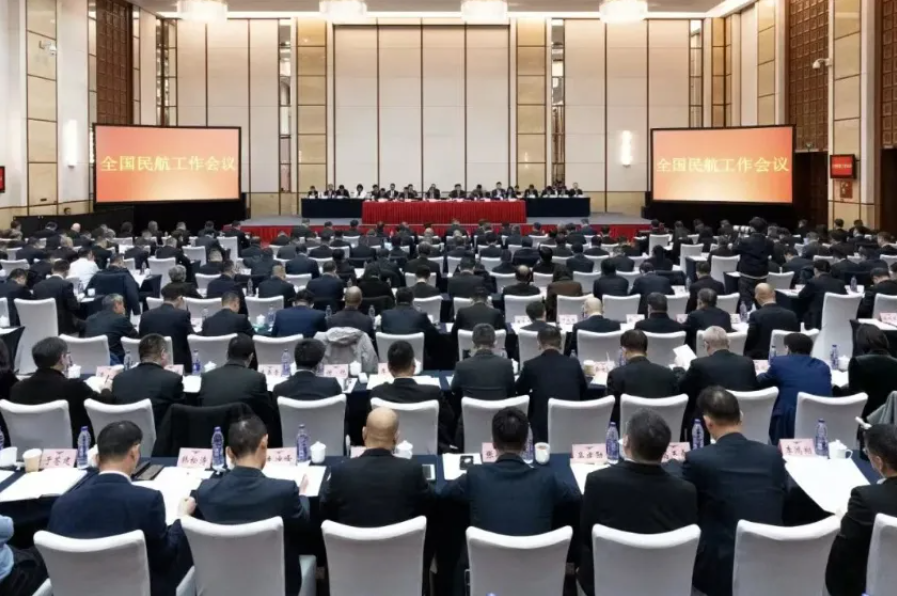
On January 6, 2026, the National Civil Aviation Work Conference was held in Beijing. Guided by Xi Jinping Thought on Socialism with Chinese Characteristics for a New Era, the conference fully implemented the spirit of the 20th National Congress of the Communist Party of China and its plenary sessions, earnestly carried out the arrangements of the Central Economic Work Conference and the requirements of the National Transportation Work Conference, systematically reviewed the work of civil aviation in 2025 and during the 14th Five-Year Plan period, coordinated and planned the work思路 for the 15th Five-Year Plan period, and studied and deployed the main tasks for 2026. Liu Wei, Minister of Transport, attended the conference and delivered a speech. Song Zhiyong, Director of the Civil Aviation Administration of China (CAAC), delivered a work report entitled "Consolidate Foundations, Make Comprehensive Efforts, and Ensure a Good Start for the 15th Five-Year Plan with Solid and Effective Work".
The conference disclosed that in 2025, traditional general aviation completed 1.218 million flight hours. The total number of registered unmanned aerial vehicles (UAVs) under real-name registration exceeded 3.28 million, with a cumulative flight time of 45.3 million hours, a year-on-year increase of nearly 70%. The CAAC formulated and promulgated implementation plans for the safe and orderly development of general aviation and low-altitude economy, issued type certificates for 6 types of unmanned aircraft, continuously optimized and improved the Unmanned Operation Management (UOM) platform for low-altitude operation supervision and services, and built and networked a total of 46 low-altitude flight service stations, initially forming a flight service network covering 23 provinces, autonomous regions and municipalities directly under the Central Government.
In 2026, civil aviation will promote the high-quality development of general aviation and low-altitude economy.
This year, the CAAC will improve the policy system for low-altitude civil aviation, accelerate the development of the low-altitude flight service station network, and advance the construction of a low-altitude flight service and dispatch platform. It will also optimize and adjust unmanned aerial vehicle test areas (test bases), and expand low-altitude application scenarios in line with local conditions.

Source: CAAC News